#96: La mano 'alien' tras un daño cerebral
May 2, 2026 - 45:55
Radio and PodcastLive Radio & Podcasts
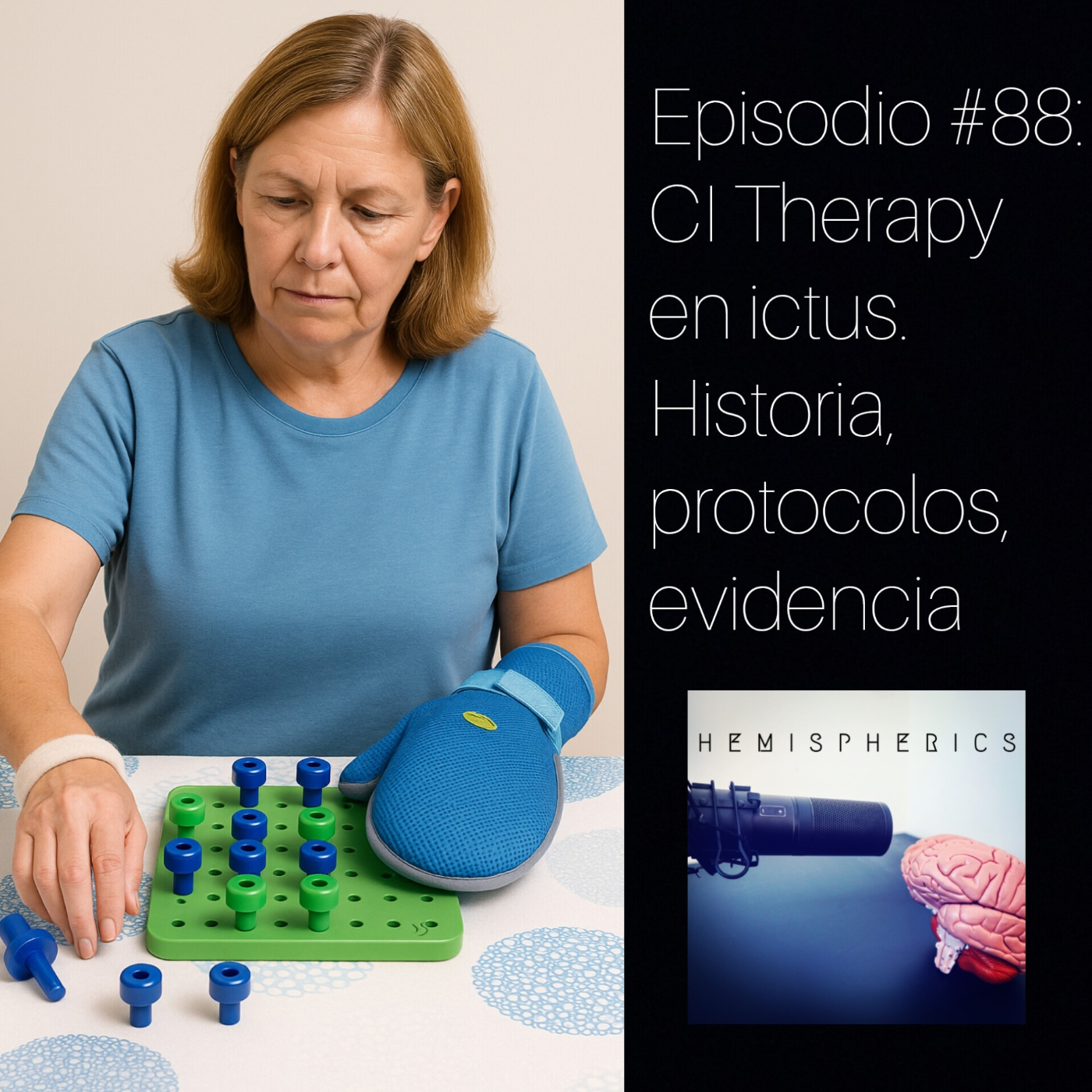
En este episodio viajamos desde los orígenes más controvertidos de la Neurociencia moderna —los monos de Silver Spring— hasta la consolidación del protocolo oficial de la Constraint-Induced Therapy (CIMT) de Taub y Morri...
#88: Constraint-Induced Therapy en ictus. Historia, protocolos y evidencia is an episode from Hemispherics by Hemispherics. En este episodio viajamos desde los orígenes más controvertidos de la Neurociencia moderna —los monos de Silver Spri...
This episode belongs to Hemispherics.
Use the player on this page to stream the episode online.
Published Dec 6, 2025, 01:00:44 long, audio available.
En este episodio viajamos desde los orígenes más controvertidos de la Neurociencia moderna —los monos de Silver Spring— hasta la consolidación del protocolo oficial de la Constraint-Induced Therapy (CIMT) de Taub y Morris en la Universidad de Alabama. Repasamos cómo surgió el concepto de learned non-use, cómo se formalizó la terapia, por qué el Paquete de Transferencia fue una revolución conductual, y qué nos dice la evidencia más robusta (incluyendo el EXCITE trial, Premio PEDro al mejor ensayo clínico del año). También exploramos la evolución del protocolo, desde las 6 horas diarias iniciales hasta el formato actual de 3.5h/día, y cómo el equipo brasileño de Sarah Dos Anjos logró expandir la CIMT al miembro inferior con resultados positivos. Cerramos con una revisión profunda del papel del MAL, del protocolo KEYS y de la extended CIMT para manos pléjicas. Un episodio imprescindible para cualquier profesional que trate a personas con ictus o quiera comprender cómo una intervención conductual intensiva puede modificar el uso real del brazo afecto… y el cerebro. Referencias del episodio: 1. Corbetta, D., Sirtori, V., Castellini, G., Moja, L., & Gatti, R. (2015). Constraint-induced movement therapy for upper extremities in people with stroke. The Cochrane database of systematic reviews, 2015(10), CD004433. ( 2. Dos Anjos, S. M., Morris, D. M., & Taub, E. (2020). Constraint-Induced Movement Therapy for Improving Motor Function of the Paretic Lower Extremity After Stroke. American journal of physical medicine & rehabilitation, 99(6), e75–e78. ( 3. Dos Anjos, S., Morris, D., & Taub, E. (2020). Constraint-Induced Movement Therapy for Lower Extremity Function: Describing the LE-CIMT Protocol. Physical therapy, 100(4), 698–707. ( 4. Dos Anjos, S., Bowman, M., & Morris, D. (2025). Effects of a Distributed Form of Constraint-Induced Movement Therapy for Clinical Application: The Keys Treatment Protocol. Brain sciences, 15(1), 87. ( 5. Gauthier, L. V., Taub, E., Perkins, C., Ortmann, M., Mark, V. W., & Uswatte, G. (2008). Remodeling the brain: plastic structural brain changes produced by different motor therapies after stroke. Stroke, 39(5), 1520–1525. ( 6. Hakkennes, S., & Keating, J. L. (2005). Constraint-induced movement therapy following stroke: a systematic review of randomised controlled trials. The Australian journal of physiotherapy, 51(4), 221–231. ( 7. Morris, D. M., Taub, E., & Mark, V. W. (2006). Constraint-induced movement therapy: characterizing the intervention protocol. Europa medicophysica, 42(3), 257–268 ( 8. Richards, L., Gonzalez Rothi, L. J., Davis, S., Wu, S. S., & Nadeau, S. E. (2006). Limited dose response to constraint-induced movement therapy in patients with chronic stroke. Clinical rehabilitation, 20(12), 1066–1074. ( 9. Sterr, A., Elbert, T., Berthold, I., Kölbel, S., Rockstroh, B., & Taub, E. (2002). Longer versus shorter daily constraint-induced movement therapy of chronic hemiparesis: an exploratory study. Archives of physical medicine and rehabilitation, 83(10), 1374–1377. ( 10. Taub, E., Miller, N. E., Novack, T. A., Cook, E. W., 3rd, Fleming, W. C., Nepomuceno, C. S., Connell, J. S., & Crago, J. E. (1993). Technique to improve chronic motor deficit after stroke. Archives of physical medicine and rehabilitation, 74(4), 347–354 ( 11. Taub, E., Uswatte, G., & Pidikiti, R. (1999). Constraint-Induced Movement Therapy: a new family of techniques with broad application to physical rehabilitation--a clinical review. Journal of rehabilitation research and development, 36(3), 237–251 ( 12. Taub, E., & Morris, D. M. (2001). Constraint-induced movement therapy to enhance recovery after stroke. Current atherosclerosis reports, 3(4), 279–286. ( 13. Taub, E., Uswatte, G., Mark, V. W., Morris, D. M., Barman, J., Bowman, M. H., Bryson, C., Delgado, A., & Bishop-McKay, S. (2013). Method for enhancing real-world use of a more affected arm in chronic stroke: transfer package of constraint-induced movement therapy. Stroke, 44(5), 1383–1388. ( 14. Uswatte, G., Taub, E., Morris, D., Barman, J., & Crago, J. (2006). Contribution of the shaping and restraint components of Constraint-Induced Movement therapy to treatment outcome. NeuroRehabilitation, 21(2), 147–156 ( 15. Uswatte, G., Taub, E., Bowman, M. H., Delgado, A., Bryson, C., Morris, D. M., Mckay, S., Barman, J., & Mark, V. W. (2018). Rehabilitation of stroke patients with plegic hands: Randomized controlled trial of expanded Constraint-Induced Movement therapy. Restorative neurology and neuroscience, 36(2), 225–244. ( 16. Wolf, S. L., Lecraw, D. E., Barton, L. A., & Jann, B. B. (1989). Forced use of hemiplegic upper extremities to reverse the effect of learned nonuse among chronic stroke and head-injured patients. Experimental neurology, 104(2), 125–132. ( 17. Wolf, S. L., Winstein, C. J., Miller, J. P., Taub, E., Uswatte, G., Morris, D., Giuliani, C., Light, K. E., Nichols-Larsen, D., & EXCITE Investigators (2006). Effect of constraint-induced movement therapy on upper extremity function 3 to 9 months after stroke: the EXCITE randomized clinical trial. JAMA, 296(17), 2095–2104. (
You can listen to #88: Constraint-Induced Therapy en ictus. Historia, protocolos y evidencia online on Radio and Podcast. Open the player on this page to stream the available audio.
#88: Constraint-Induced Therapy en ictus. Historia, protocolos y evidencia is an episode from Hemispherics by Hemispherics.
This episode is 01:00:44 long.
This episode was published on Dec 6, 2025.
Yes. Use the heart button on the episode page to add it to your favorite episodes list.
Yes. This page shows related episodes from Hemispherics when more episodes are available from the podcast feed.
You can listen to #88: Constraint-Induced Therapy en ictus. Historia, protocolos y evidencia on this page when the episode audio is available from the podcast feed.
#88: Constraint-Induced Therapy en ictus. Historia, protocolos y evidencia is from Hemispherics by Hemispherics.
Published Dec 6, 2025 and 01:00:44 long