#96: La mano 'alien' tras un daño cerebral
May 2, 2026 - 45:55
Radio and PodcastLive Radio & PodcastsFetching episode details...
Radio and PodcastLive Radio & Podcasts
En este episodio nos metemos en un fenómeno tan curioso como clínicamente muy revelador: qué pasa cuando una persona bilingüe sufre un daño cerebral y, de repente, uno de sus idiomas parece desaparecer mientras el otro s...
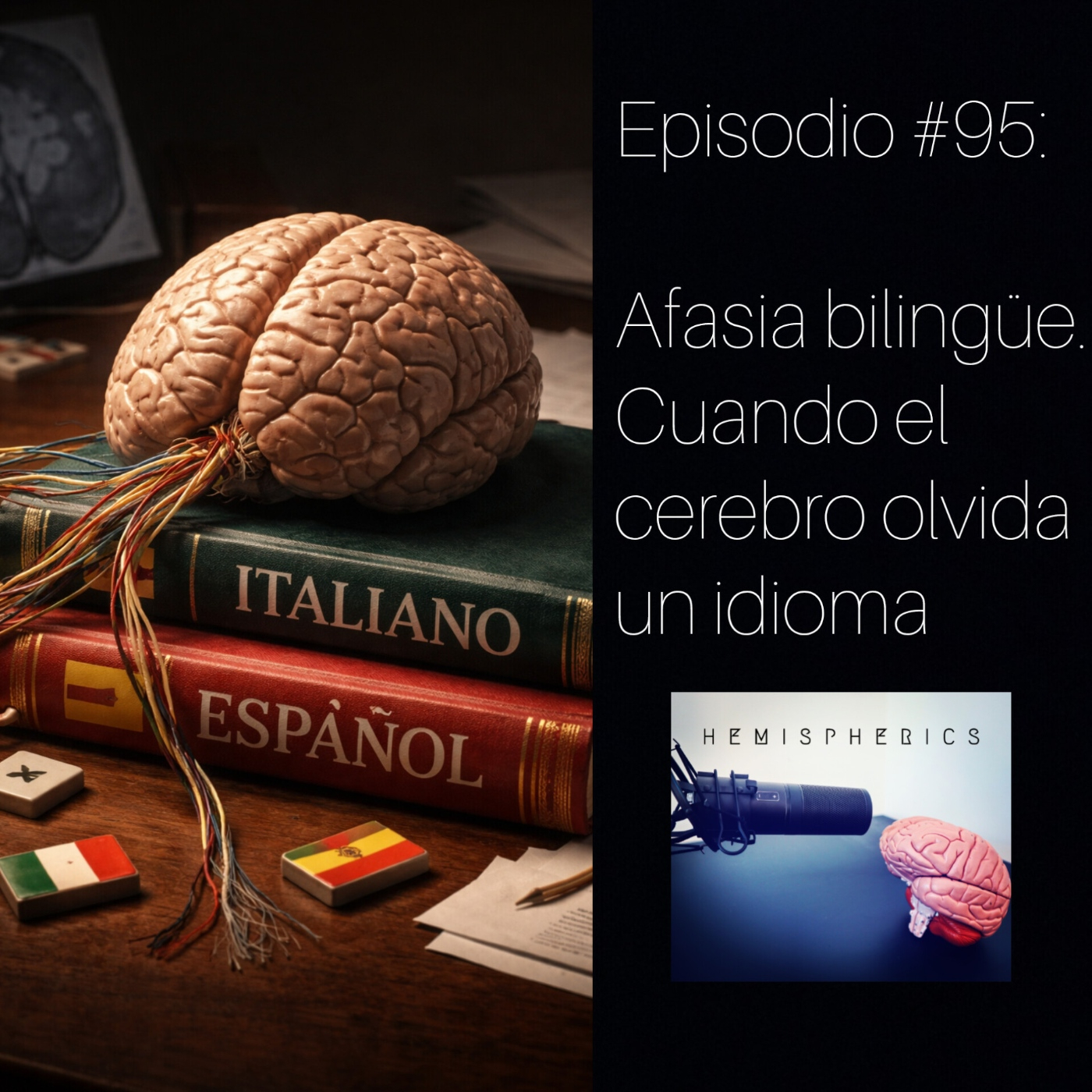
#95: Afasia bilingüe. Cuando el cerebro olvida un idioma is an episode from Hemispherics by Hemispherics. En este episodio nos metemos en un fenómeno tan curioso como clínicamente muy revelador: qué pasa cuando una persona bilingüe sufre un...
This episode belongs to Hemispherics.
Use the player on this page to stream the episode online.
Published Apr 18, 2026, 54:26 long, audio available.
En este episodio nos metemos en un fenómeno tan curioso como clínicamente muy revelador: qué pasa cuando una persona bilingüe sufre un daño cerebral y, de repente, uno de sus idiomas parece desaparecer mientras el otro se mantiene. A partir de ahí, aprovechamos para repensar cómo se organiza realmente el lenguaje en el cerebro, alejándonos de la idea clásica de “zonas” y acercándonos a una visión mucho más dinámica, basada en redes que interactúan constantemente. Hablamos de por qué no todos los idiomas se afectan igual, qué papel tienen factores como el uso previo o la edad de adquisición, y por qué la recuperación puede ser tan variable entre pacientes. También aterrizamos todo esto en la clínica, viendo qué implicaciones tiene para la neurorrehabilitación y cómo trabajar con pacientes bilingües. En el fondo, es un episodio que va más allá de la afasia bilingüe y que nos ayuda a entender algo más profundo: que el lenguaje no está guardado en compartimentos, sino que es un sistema flexible que el cerebro reorganiza cuando algo se rompe. Referencias del episodio: 1. Abutalebi, J., & Green, D. W. (2007). Bilingual language production: The neurocognition of language representation and control. Journal of Neurolinguistics, 20(3), 242–275. 2. Abutalebi, J., Della Rosa, P. A., Gonzaga, A. K., Keim, R., Costa, A., & Perani, D. (2013). The role of the left putamen in multilingual language production. Brain and language, 125(3), 307–315. ( 3. Abutalebi, J., Canini, M., Della Rosa, P. A., Green, D. W., & Weekes, B. S. (2015). The neuroprotective effects of bilingualism upon the inferior parietal lobule: A structural neuroimaging study in aging Chinese bilinguals. Journal of Neurolinguistics, 26(6), 602–609 ( 4. Ardila, A., Lahiri, D., & Mukherjee, A. (2023). Bilingualism as a protective factor in aphasia. Applied neuropsychology. Adult, 30(5), 512–520. ( 5. Berthier, M. L. (2005). Poststroke aphasia: Epidemiology, pathophysiology and treatment. Drugs & Aging, 22(2), 163–182. ( 6. Bihovsky, A., Ben-Shachar, M., & Meir, N. (2024). Semantic feature analysis (SFA) treatment in L1 and L2 in bilingual aphasia: Effects of cognitive and language factors. Aphasiology, 38(4), 683–711 ( 7. Dekhtyar, M., Kiran, S., & Gray, T. (2020). Is bilingualism protective for adults with aphasia?. Neuropsychologia, 139, 107355. ( 8. Edmonds, L. A., & Kiran, S. (2006). Effect of semantic naming treatment on crosslinguistic generalization in bilingual aphasia. Journal of speech, language, and hearing research : JSLHR, 49(4), 729–748. ( 9. Goral, M., Levy, E. S., & Kastl, R. (2007). Cross-language treatment generalisation: A case of trilingual aphasia. Aphasiology, 103(1-2), 203–204. ( 10. Hickok, G., & Poeppel, D. (2007). The cortical organization of speech processing. Nature reviews. Neuroscience, 8(5), 393–402. ( 11. Indefrey, P. (2006). A meta-analysis of hemodynamic studies on first and second language processing. Human Brain Mapping, 27(10), 799–810. ( 12. Jouravlev, O., Mineroff, Z., Blank, I. A., & Fedorenko, E. (2021). The Small and Efficient Language Network of Polyglots and Hyper-polyglots. Cerebral cortex (New York, N.Y. : 1991), 31(1), 62–76. ( 13. Malik-Moraleda, S., Ayyash, D., Gallée, J., Affourtit, J., Hoffmann, M., Mineroff, Z., Jouravlev, O., & Fedorenko, E. (2022). An investigation across 45 languages and 12 language families reveals a universal language network. Nature neuroscience, 25(8), 1014–1019. ( 14. Malik-Moraleda, S., Jouravlev, O., Taliaferro, M., Mineroff, Z., Cucu, T., Mahowald, K., Blank, I. A., & Fedorenko, E. (2024). Functional characterization of the language network of polyglots and hyperpolyglots with precision fMRI. bioRxiv : the preprint server for biology, 2023.01.19.524657. ( 15. Nadeau, S. E. (2019). Neural basis of language: A population encoding perspective. Language, Cognition and Neuroscience, 34(1), 1–18. 16. Paplikar, A., Mekala, S., Bak, T. H., Dharamkar, S., Alladi, S., & Kaul, S. (2018). Bilingualism and the severity of poststroke aphasia. Aphasiology, 33(1), 58–72. 17. Pliatsikas, C. (2020). Understanding structural plasticity in the bilingual brain: The Dynamic Restructuring Model. Bilingualism: Language and Cognition, 23(2), 459–471. 18. Price C. J. (2012). A review and synthesis of the first 20 years of PET and fMRI studies of heard speech, spoken language and reading. NeuroImage, 62(2), 816–847. 19. Russell-Meill, M., Marte, M. J., Carpenter, E., & Kiran, S. (2025). Navigating the Complexity of Bilingual Aphasia: Current Insights and Future Directions. Brain sciences, 15(9), 989. (
You can listen to #95: Afasia bilingüe. Cuando el cerebro olvida un idioma online on Radio and Podcast. Open the player on this page to stream the available audio.
#95: Afasia bilingüe. Cuando el cerebro olvida un idioma is an episode from Hemispherics by Hemispherics.
This episode is 54:26 long.
This episode was published on Apr 18, 2026.
Yes. Use the heart button on the episode page to add it to your favorite episodes list.
Yes. This page shows related episodes from Hemispherics when more episodes are available from the podcast feed.
You can listen to #95: Afasia bilingüe. Cuando el cerebro olvida un idioma on this page when the episode audio is available from the podcast feed.
#95: Afasia bilingüe. Cuando el cerebro olvida un idioma is from Hemispherics by Hemispherics.
Published Apr 18, 2026 and 54:26 long