Radio and PodcastRadio and PodcastLive Radio & Podcasts
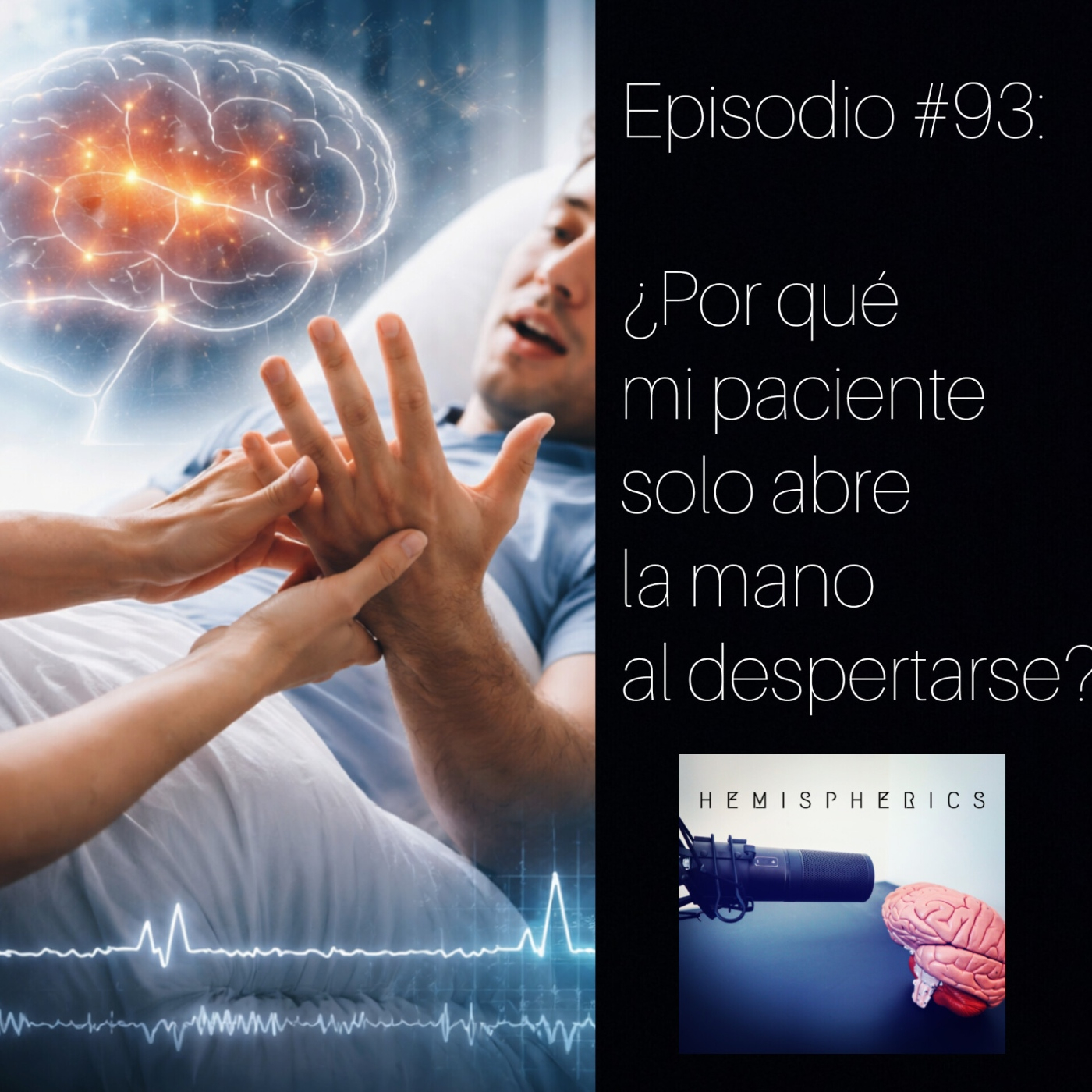
#93: ¿Por qué mi paciente sólo abre la mano al despertarse? artwork
Science & Medicine

#93: ¿Por qué mi paciente sólo abre la mano al despertarse?

Hemispherics by Hemispherics

Mar 14, 202632:38Science & Medicine

En este episodio exploramos un fenómeno clínico sorprendente que algunos terapeutas han observado en pacientes con daño cerebral: personas que durante el día no pueden abrir la mano voluntariamente, pero que, justo al de...

About This Episode

#93: ¿Por qué mi paciente sólo abre la mano al despertarse? is an episode from Hemispherics by Hemispherics. En este episodio exploramos un fenómeno clínico sorprendente que algunos terapeutas han observado en pacientes con daño cerebral: p...

Podcast

This episode belongs to Hemispherics.

Listen Online

Use the player on this page to stream the episode online.

Episode Details

Published Mar 14, 2026, 32:38 long, audio available.

Questions About This Episode

What is #93: ¿Por qué mi paciente sólo abre la mano al despertarse? about?

En este episodio exploramos un fenómeno clínico sorprendente que algunos terapeutas han observado en pacientes con daño cerebral: personas que durante el día no pueden abrir la mano voluntariamente, pero que, justo al despertarse, sí consiguen hacerlo durante unos segundos o minutos. A partir de un caso real, analizamos qué podría estar ocurriendo en el sistema nervioso para que aparezca esta “ventana motora” transitoria. El episodio revisa cómo las alteraciones del equilibrio entre el tracto corticoespinal y las vías cortico-reticuloespinales pueden favorecer patrones globales como la sinergia flexora, que terminan “secuestrando” la apertura de la mano durante la actividad diaria. A lo largo del episodio se propone una explicación integradora basada en tres factores clave: el estado de activación del sistema nervioso al despertar, la neuromodulación monoaminérgica que regula la excitabilidad de las motoneuronas y las corrientes internas (PICs), y el papel crucial de la biomecánica y la postura del miembro superior. Esta combinación podría generar una breve fase de menor hiperactividad flexora que permite emerger al movimiento. Más allá de la curiosidad clínica, el episodio plantea una pregunta terapéutica fundamental: si entendemos por qué aparece esa ventana, ¿podemos reproducirla y utilizarla en rehabilitación para entrenar la apertura de la mano? Referencias del episodio: 1. Bertini, M., Ferrara, M., De Gennaro, L., Curcio, G., Fratello, F., Romei, V., Pauri, F., & Rossini, P. M. (2004). Corticospinal excitability and sleep: a motor threshold assessment by transcranial magnetic stimulation after awakenings from REM and NREM sleep. Journal of sleep research, 13(1), 31–36. ( 2. De Gennaro, L., Bertini, M., Ferrara, M., Curcio, G., Cristiani, R., Romei, V., Fratello, F., Pauri, F., & Rossini, P. M. (2004). Intracortical inhibition and facilitation upon awakening from different sleep stages: a transcranial magnetic stimulation study. The European journal of neuroscience, 19(11), 3099–3104. ( 3. Dewald, J. P., & Beer, R. F. (2001). Abnormal joint torque patterns in the paretic upper limb of subjects with hemiparesis. Muscle & nerve, 24(2), 273–283. 3.0.co;2-z ( 4. Ferrara, M., & De Gennaro, L. (2000). The sleep inertia phenomenon during the sleep-wake transition: theoretical and operational issues. Aviation, space, and environmental medicine, 71(8), 843–848 ( 5. Heckman, C. J., Mottram, C., Quinlan, K., Theiss, R., & Schuster, J. (2009). Motoneuron excitability: the importance of neuromodulatory inputs. Clinical neurophysiology : official journal of the International Federation of Clinical Neurophysiology, 120(12), 2040–2054. ( 6. Heckman, C. J., Johnson, M., Mottram, C., & Schuster, J. (2008). Persistent inward currents in spinal motoneurons and their influence on human motoneuron firing patterns. The Neuroscientist : a review journal bringing neurobiology, neurology and psychiatry, 14(3), 264–275. ( 7. Huber, R., Mäki, H., Rosanova, M., Casarotto, S., Canali, P., Casali, A. G., Tononi, G., & Massimini, M. (2013). Human cortical excitability increases with time awake. Cerebral cortex (New York, N.Y. : 1991), 23(2), 332–338. ( 8. Lan, Y., Yao, J., & Dewald, J. P. A. (2017). The Impact of Shoulder Abduction Loading on Volitional Hand Opening and Grasping in Chronic Hemiparetic Stroke. Neurorehabilitation and neural repair, 31(6), 521–529. ( 9. Li, S., & Francisco, G. E. (2015). New insights into the pathophysiology of post-stroke spasticity. Frontiers in human neuroscience, 9, 192. ( 10. Manganotti, P., Fuggetta, G., & Fiaschi, A. (2004). Changes of motor cortical excitability in human subjects from wakefulness to early stages of sleep: a combined transcranial magnetic stimulation and electroencephalographic study. Neuroscience letters, 362(1), 31–34. ( 11. McPherson, J. G., Chen, A., Ellis, M. D., Yao, J., Heckman, C. J., & Dewald, J. P. A. (2018). Progressive recruitment of contralesional cortico-reticulospinal pathways drives motor impairment post stroke. The Journal of physiology, 596(7), 1211–1225. ( 12. Menon, J. M. L., Nolten, C., Achterberg, E. J. M., Joosten, R. N. J. M. A., Dematteis, M., Feenstra, M. G. P., Drinkenburg, W. H. P., & Leenaars, C. H. C. (2019). Brain Microdialysate Monoamines in Relation to Circadian Rhythms, Sleep, and Sleep Deprivation - a Systematic Review, Network Meta-analysis, and New Primary Data. Journal of circadian rhythms, 17, 1. ( 13. Monti J. M. (2011). Serotonin control of sleep-wake behavior. Sleep medicine reviews, 15(4), 269–281. ( 14. Siegel J. M. (2004). The neurotransmitters of sleep. The Journal of clinical psychiatry, 65 Suppl 16(Suppl 16), 4–7 ( 15. Tauber, E. S., Coleman, R. M., & Weitzman, E. D. (1977). Absence of tonic electromyographic activity during sleep in normal and spastic nonmimetic skeletal muscles in man. Annals of neurology, 2(1), 66–68. ( 16. Vyazovskiy, V. V., & Delogu, A. (2014). NREM and REM Sleep: Complementary Roles in Recovery after Wakefulness. The Neuroscientist : a review journal bringing neurobiology, neurology and psychiatry, 20(3), 203–219. ( 17. Walusinski, O., Neau, J. P., & Bogousslavsky, J. (2010). Hand up! Yawn and raise your arm. International journal of stroke : official journal of the International Stroke Society, 5(1), 21–27. (

Where can I listen to #93: ¿Por qué mi paciente sólo abre la mano al despertarse??

You can listen to #93: ¿Por qué mi paciente sólo abre la mano al despertarse? online on Radio and Podcast. Open the player on this page to stream the available audio.

Which podcast is #93: ¿Por qué mi paciente sólo abre la mano al despertarse? from?

#93: ¿Por qué mi paciente sólo abre la mano al despertarse? is an episode from Hemispherics by Hemispherics.

How long is this episode?

This episode is 32:38 long.

When was this episode published?

This episode was published on Mar 14, 2026.

Can I save #93: ¿Por qué mi paciente sólo abre la mano al despertarse? for later?

Yes. Use the heart button on the episode page to add it to your favorite episodes list.

Are there related episodes from Hemispherics?

Yes. This page shows related episodes from Hemispherics when more episodes are available from the podcast feed.

Quick Answers About This Episode

Where can I listen to #93: ¿Por qué mi paciente sólo abre la mano al despertarse??

You can listen to #93: ¿Por qué mi paciente sólo abre la mano al despertarse? on this page when the episode audio is available from the podcast feed.

Which podcast is this episode from?

#93: ¿Por qué mi paciente sólo abre la mano al despertarse? is from Hemispherics by Hemispherics.

What are the episode details?

Published Mar 14, 2026 and 32:38 long