Radio and PodcastRadio and PodcastLive Radio & Podcasts
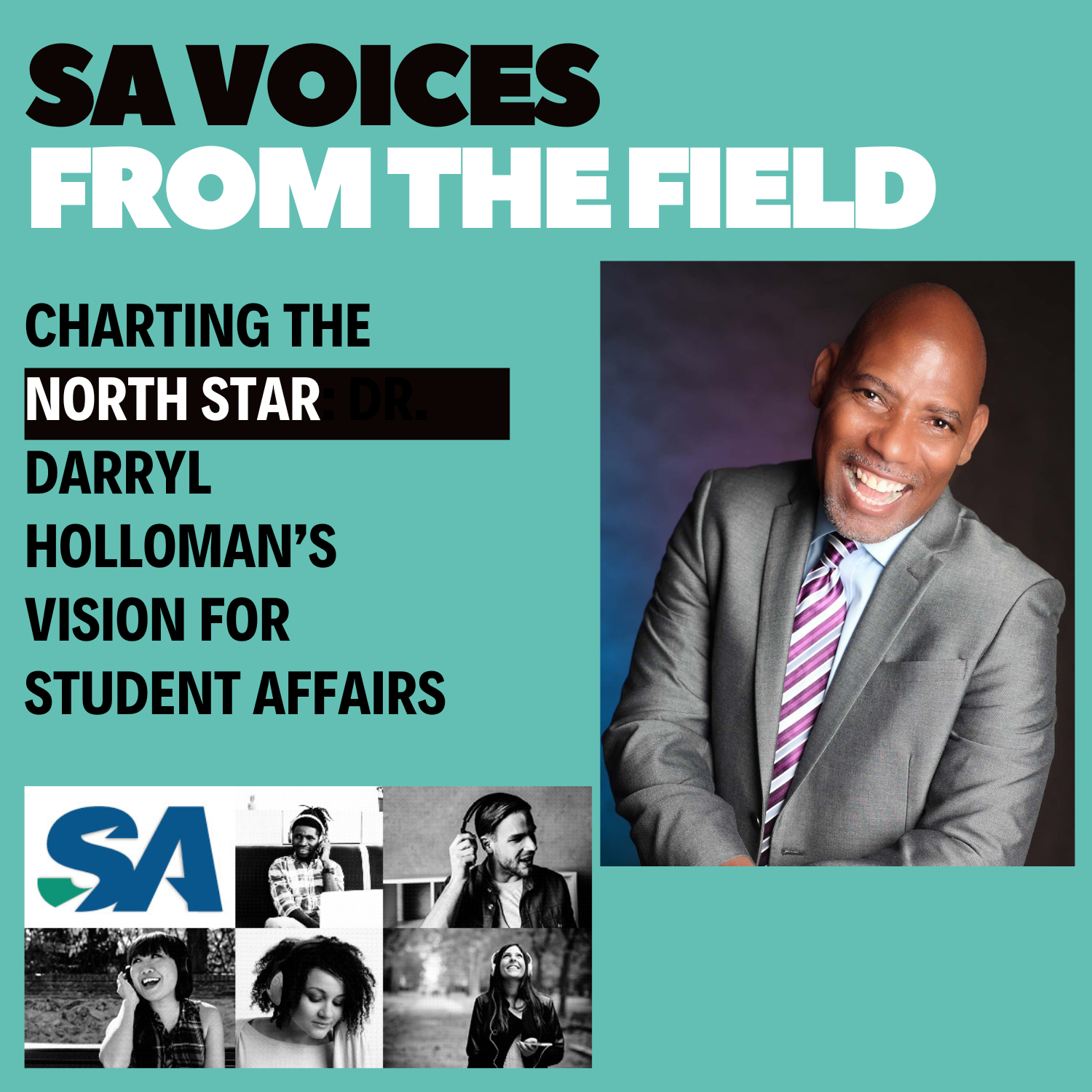
Charting the North Star: Dr. Darryl Holloman's Vision for Student Affairs artwork
Education

Charting the North Star: Dr. Darryl Holloman's Vision for Student Affairs

SA Voices From the Field by NASPA Student Affairs Professionals in Higher Education

Feb 13, 202644:16Education

The latest episode of Student Affairs Voices from the Field kicks off Season 14 with a truly inspiring conversation with incoming NASPA Board Chair, Dr. Darryl Holloman . Hosted by Dr. Jill Creighton , the episode dives...

About This Episode

Charting the North Star: Dr. Darryl Holloman's Vision for Student Affairs is an episode from SA Voices From the Field by NASPA Student Affairs Professionals in Higher Education. The latest episode of Student Affairs Voices from the Field ki...

Podcast

This episode belongs to SA Voices From the Field.

Listen Online

Use the player on this page to stream the episode online.

Episode Details

Published Feb 13, 2026, 44:16 long, audio available.

Questions About This Episode

What is Charting the North Star: Dr. Darryl Holloman's Vision for Student Affairs about?

The latest episode of Student Affairs Voices from the Field kicks off Season 14 with a truly inspiring conversation with incoming NASPA Board Chair, Dr. Darryl Holloman . Hosted by Dr. Jill Creighton , the episode dives deep into the evolving landscape of higher education and what it means to work in student affairs today. Dr. Holloman brings over three decades of experience to the table, spanning roles at HBCUs, PWIs, and across governance, academic administration, and talent management. His journey to Vice President for Student Affairs at Spelman College is a testament to the power of mentorship, professional exploration, and seizing unexpected opportunities. The conversation focuses on the value and challenges facing student affairs professionals, particularly in a period marked by ongoing turmoil—post-pandemic disruption, shifting enrollment, and threats to DEI initiatives. Dr. Holloman emphasizes the need to move beyond accepting the "new normal" and instead frame current challenges as "new possibilities," encouraging professionals to be both forward-ready and future-ready. At the heart of his vision is the "North Star Project," an initiative designed to reclaim public trust and redefine the purpose of higher education. This multifaceted endeavor includes three key arms: Rebuilding Public Trust Survey : A national study examining how those outside higher ed perceive colleges and universities, pushing for deeper understanding beyond the usual Gallup poll data. New Professional Task Force : A focus on early-career professionals, listening deeply to their needs, and developing skill-building opportunities—like real-time badging systems—to help retain talent and strengthen the student affairs pipeline. NASPA Commission on HBCU and Community College Pathways : An effort to amplify the voices of HBCUs and community colleges within NASPA's governance, reflecting their crucial roles in access and mission-driven education. Dr. Holloman's personal values—knowledge, God, family, humility, and hard work—shine throughout the discussion, reinforcing the importance of aligning purpose and professional philosophy. If you're looking for insight into the future of student affairs, practical strategies for professional development, and a fresh take on the value of our field, this is a must-listen. Tune in to hear how Dr. Holloman and NASPA are charting a new course, and discover ways to get involved in shaping the next chapter. Listen to the episode and join the conversation! TRANSCRIPT Dr. Jill Creighton [00:00:01]: Welcome to Student Affairs Voices from the Field, the podcast where we share your student affairs stories from fresh perspectives to seasoned experts. Brought to you by NASPA, we curate free and accessible professional development for higher education professionals wherever you happen to be. This is Season 14, continuing our conversation on the value of student affairs. I'm Dr. Jill Creighton, she/her/hers, your SA Voices from the Field host. Welcome back to Student Affairs Voices from the Field. We are thrilled to kick off our current season with Dr. Darryl B. Dr. Jill Creighton [00:00:33]: Holloman, who is a distinguished leader in higher education with over 3 decades of experience in student affairs, academic administration, institutional advancement, governance and board relations, and human talent management. Dr. Holloman has worked at several regional and nationally recognized higher education institutions where he supervised collectively over 300 employees and overseen budgets of over $300 million. Dr. Holloman's extensive experience strategically vision and unwavering commitment to student success and institutional excellence make him a transformative leader in higher ed. He currently serves as the VPSA at Spelman College, but he's held senior-level positions at Georgia State University, Columbus State University, and Rutgers University-Newark. He's held faculty appointments at each institution, including full-time faculty appointments at the University of Arkansas-Little Rock and the institutions aforementioned. His contributions continue to inspire and shape the future of academic communities. Dr. Jill Creighton [00:01:23]: Dr. Holloman has several articles and book chapters to his credit. His research examines the way that disadvantage manage groups, develop, and demonstrate their agency in educational systems, particularly within urban school settings. He's the co-editor of the book entitled From Boyhood to Manhood: Deconstructing Black Masculinity Through a Lifespan Continuum through Peter Lang Press. His most current manuscript is entitled In the Middle: Leading as a Mid-Level Professional in Student Affairs, which was published by NASPA. He's an active member of St. Luke's Episcopal Church, and he lives in Atlanta with a spouse of 32 years, Glenn Williams, and their two sons, Delbert and Delvin. But most importantly, and why we have him on pod today as he is our incoming NASPA Board Chair. Dr. Jill Creighton [00:02:04]: We hope you enjoy this conversation. Darryl, welcome to SA Voices. Dr. Darryl Holloman [00:02:08]: Thank you so much. I'm glad to be here. Dr. Jill Creighton [00:02:11]: We are absolutely honored to have you as our season premiere for this season of SA Voices here in spring of 2026, and you are joining us in a long and illustrious line of NASPA Board Chairs-to-be. It's one of our favorite episodes to record in the springtime. Last, last year we had Mike Christakis on who is just finishing up his full year as Board Chair. And in just a couple of weeks now, that gavel will be passing your way. So this episode is one where we like to introduce you to the NASPA membership, what you hope that your leadership will bring to the association over the next year, and messages for our NASPA membership. So before we get into all of that, our favorite question to start the show off with is how did you get to your current seat, both at Spelman and at NASPA? Dr. Darryl Holloman [00:02:59]: Well, I got to Spelman. It was a really interesting journey because I was serving on the board of a local charter school. And the guy that we hired as a CEO said, hey, I really want you to meet my mom. And his mom works at Spelman. She's still on my staff at Spelman. And he's, you know, we just, let's go to lunch. And so we went to lunch. And at that time I was AVP Dean of Students at Georgia State University. Dr. Darryl Holloman [00:03:23]: And I was starting to think about, you know, where would I go to be a vice president for student affairs? I have this lunch and at the end of the lunch, my colleague said, "Hey, you should apply at Spelman. We have an opening." And at that time, I said, "Oh, okay, sure, I'll look at it." But, you know, Spelman is an all-women's HBCU in Atlanta. I've not ever worked at an HBCU. I've not worked at a liberal arts college, small college, and definitely an all-women's college. And so I applied. I applied with 6 very wonderful women. Half of them I knew very personally. And then I got the call that I had the job, which totally caught me off guard because it was— was not in the trajectory of where I thought my career was going. Dr. Darryl Holloman [00:04:07]: I had worked— done most of my work at large, larger public institutions, predominantly white institutions. And so I got the job. I have had a tremendous, tremendous experience here. I got to NASPA 30 years ago. I had a dean of students, Dean Curt Kepler, who hired me. I was a student worker, and then he hired me on as a staff. And he said I should go to this thing called a new professional institute. And at that time, NASPA had this nationwide platform, onboarding new professionals, and it was at UGA, and it was so impactful that it led me into a lifelong volunteer commitment with NASPA, and it's been extremely rewarding, and I've, I've just done so many things, have so many opportunities, have an upcoming book in the middle, co-edited with Gigi Segubin and Spencer Platt, that'll be coming out in the spring. Dr. Darryl Holloman [00:04:57]: So there's so many wonderful opportunities to NASPA, so I've just been really blessed professionally and in my volunteer activities. Dr. Jill Creighton [00:05:04]: What have you done in NASPA in terms of volunteerism, leadership, contribution before deciding to run for board chair? Dr. Darryl Holloman [00:05:12]: So I had a wonderful opportunity from one of, one of my colleagues, Danita Brown-Young. And Danita, she called me, she said, hey, I think I want you to be my member at large, and I want you to focus on how can NASPA better support HBCUs. And so I joined the board. We did surveys, like some really great work around that, but that really gave me gave me some great insight into how NASPA runs as an organization, the work that it does, the commitments that it makes, and, you know, kind of the engine in the car. And so that was very powerful for me to be able to have that experience as a member board chair. Prior to that, and this was really a great experience for me, I had joined the NASPA Foundation Board, and those two in tandem have been really helpful to help me understand not just in NASPA, but how organizations run, how nonprofits run, how boards run, the decisions that have to be made. And so it's just been a wonderful experience. And outside of presenting and doing some of the other stuff, those have been the most significant governance opportunities that I've had at NASPA. Dr. Jill Creighton [00:06:19]: And now let's think about what is ahead. So again, in just a couple of weeks here, we'll be seeing you in Kansas City. The board will be convening, the membership will be convening for our annual learning opportunity at conference. What are you thinking about going into this transition? Dr. Darryl Holloman [00:06:35]: So, you know, we are in such turmoil right now in higher ed. You know, we followed the pandemic. It was very, very much a disruptor. And then now we're just faced with a lot of challenges, enrollment cliffs, DEI leaving many of our institutions that have become such a part of our fabric, funding in so many ways, federal funding being taken. So it's a real difficult time. And I think I keep hearing people talk about this is our new normal. This is our new normal. And I want to really challenge us to start to think beyond that and to think, how do we turn our new normal into new possibilities? And how can we be more forward-ready and future-ready? And I think the best way for us to do that as an association is to really lean into our memberships. Dr. Darryl Holloman [00:07:23]: I think sometimes when you work in student affairs, we have such an emphasis on students, and that should be, that's important. That's, that's our lifeblood. But if we are not in really good spaces in terms of our our own professional development, our own training, our own understanding, if we are not having holistic wellness, then we can't do the work that we need to do. We don't have the capacity to do it for students. And so my idea is kind of wrapped into what I'm calling the North Star Project. The North Star historically had been seen as a symbol in African American communities as that guiding point, that place that took you from oppression to a place of freedom and enlightenment. And so, um, The North Star Project is all about reclaiming the purpose and public trust of higher education, because I do believe there's a lack of trust in higher education. And so I have three arms of the North Star Project. Dr. Darryl Holloman [00:08:17]: One is a national study that is being conducted by Tim Bono, who is my member at large. And we really, through the Rebuilding Public Trust national survey, we want to get an understanding of how people outside of higher ed view us. And so we're kind of expanding upon the Gallup poll. The Gallup poll tells us there's a lack of confidence in higher education, but we want to drill down a little bit deeper and know why. Because I think a lot of times in higher ed, we preach to the choir and we're talking to one another and we really don't know often what are the perceptions of individuals who maybe not have even attended college. And so to be stronger, I think we need that information. And so Tim Bono will be doing that national survey. Survey on the trust in higher education, the confidence in higher education. Dr. Darryl Holloman [00:09:07]: Very excited about that. I've seen the survey a bit to get the results and see what happens. The next thing is, as I mentioned earlier, something that impacted my career. And so I'm really looking to bring together a group of people under the new professional task force to get a better understanding of professionals that are coming in with 1 to 5 years of experience. And I think we have a flood of new professionals that think differently about the work, that perceive the work differently. In my generation, I'm a Gen Xer, my generation has a tendency to keep saying like, why don't they just do like we did? But it's a different time. They're presented with way different challenges, having to make decisions in a very different way and under a lot of pressure. And so I'm really interested in seeing how our association can pour into our new professionals. Dr. Darryl Holloman [00:09:57]: And so the New Professional Task Force is all about strengthening the student affairs pipeline because what What I'm hearing now are senior-level people who are just really, really burned out. I jokingly say we're all a lottery ticket away from not being vice presidents of student affairs. And then I think you have mid-levels who see the stressors that the VP does and they don't wanna do it. And they're like, I'm fine. Like, I'm, I'm gonna stay in this role. I'm good. I don't need to be the vice president. And then you have new professionals who are coming in with a different set of expectations. Dr. Darryl Holloman [00:10:32]: And so I think starting at the front end of the pipeline will help us to guide people to those senior-level positions. And the last thing is a NASPA commission on HBCU and community college pathways, because I think these institutions provide a lot of opportunities for students. Many are access-driven, deeply mission-driven. And I think what I'm seeing definitely at HBCUs is a resurgence of high school students who are interested in HBCUs. They're kind of seeing some of the ultra micro-aggressions the oppressions that are occurring in society, and they're looking for space that affirm them and validate them. And so HBCUs play a critical role in being able to do that. And so I think it's critically important in the alignment with HBCUs is really focusing also on community colleges. Our country is really beginning deep discussions about affordability and what that means. Dr. Darryl Holloman [00:11:28]: And we've been talking about that in higher ed for like the last 20 years of affordability. And you can't have a conversation about affordability and being able to manage loan debt in higher education without also thinking about community colleges and the works that occur within community colleges. I'm extremely excited about this initiative because I think our association has an opportunity to better understand the needs and the engagements at HBCUs and community colleges and really figuring out how we not only have these members as participants, but how do we get them as well into governance structures. Cultures. I'll use, for example, HBCUs. I don't always want to be the only HBCU voice in the room because we're all so very different. About 103 HBCUs, all institutions with different types, different missions, and that brings a different type of voice into the room. So the North Star Project really is comprised of three arms. Dr. Darryl Holloman [00:12:29]: It is rebuilding public trust survey, trying to gather and gain information about how people view us on the outside. Pulling together a group to look at the new professional task force, which is about strengthening student affairs pipeline. And the last is the NASPA Commission on HBCU and community college pathways. So we get a better understanding of how we can support this sector of our field. Dr. Jill Creighton [00:12:53]: I really like your theme of it being the North Star and being our guiding light for the profession and helping us find some direction as professionals. And I'd like to take these one by one. The first project being that external survey, who are we surveying to ask about the perceptions of higher education? Dr. Darryl Holloman [00:13:09]: So we are specifically looking for folks who are— that don't work in higher education, that may not have attended higher education. And so it is the segment of the population that probably have the most questions about higher education and the value of higher education. But we're also in that survey will be included people who graduated from colleges. And so I think there are segments of our population who have— we've been required to get graduate degrees. And I think there's some frustration about that, right? You've gone to college, you've spent a lot of money, and then you're not working in your major. You're not working in the field that you thought you were, and you have all of this college debt and this degree that you may not be having the best usage of. And so it's gonna be a combination of people that are completely outside of higher education. So it won't be us speaking to us. Dr. Darryl Holloman [00:14:05]: It will be really gathering the ideas and perspectives of people outside. So for one of the questions that I can remember, we are looking at college presidents asking the question about senior leaders in higher education. Do people even know what a college president is supposed to do? Do you have perceptions about that? But I think we may be— college presidents may be out of sync with what society is expecting of a college president. And so we just want to get some cleaner insight, deeper insight into the work that we do. It's almost like a 360 for higher education. Dr. Jill Creighton [00:14:40]: I think that's an interesting statement that maybe the general public doesn't know what a university president does, but I also wonder often if internally within our organizations, we all know what a college president does, especially if we're several hierarchical layers removed from that position. We've talked to several college presidents on the pod who have been former VPSAs, and I think our student affairs folks, we all know what a VPSA does, but that college presidency is a little bit mystical sometimes. And some of the presidents that we've spoken to are focused on fundraising, some are focused on legislative action, but almost all of them seem to be externally focused more than internally focused right now. And I think that's an interesting shift. Dr. Darryl Holloman [00:15:19]: And I was talking about this with a friend that, you know, probably 50 years ago, people talked about— they were— I'll use Georgia State as an example, right? Not, not to say that the Georgia State president says this, but, you know, they would say, I am Georgia State's president. Right? But now I think people think, I am the president of XYZ institution. And it's a small nuance in the differences of that. But saying, I am Georgia State's president, or I'm said institution's president, puts the president really in the center of the mission, that they are part of the community. But when you start to say, I am the president of X, it almost makes it it feel as if, you know, and you rightfully so, the leader, but you're in this kind of real corporate leader mind, you know, kind of mindset and running. And I think just over time, the idea of what it means to be a college president has changed so drastically that I wonder sometimes if some college presidents even— I think they get surprised when they get into the role and they figure out it is not necessarily what they may have thought it was going to be, because it's a definite difference in being a college president today. You're running more of an enterprise now than just a college. And I think that sense of higher ed being an enterprise is where I think communities are feeling like, well, I don't understand, like, what does the college president do? And so getting information on the outside, I think helps to inform and align the expectations of what college presidents are doing in society today. Dr. Jill Creighton [00:16:54]: Absolutely. I'll be very much looking forward to learning what we learn, because I think we have kind of our own narrative. Our own communities about what we hear from friends, family, social spaces, what, you know, what we do at universities and especially in the American context right now, there's a lot shifting about higher education and the perception of higher ed. Let's go to that second part of the North Star Project, which is the new professional pipeline. That 1 to 5 year space, I think is incredibly critical as we're seeing a generational shift of who's occupying that 1 to 5 year space. We're seeing the last of the millennials come through the early stages of Gen Z coming into student affairs. And you mentioned that we're seeing seeing different value set come forward from this generation. And one thing that I have noticed and very much appreciate is a focus on work-life balance from this generation. Dr. Jill Creighton [00:17:42]: And I don't mean work-life integration. I truly mean balance of people that are much more comfortable advocating for that balance and maybe shouldn't have to advocate for that balance because we need to do a better job of modeling it as the senior leaders. But the space that's occupied has also consistently been one that requires a master's degree to enter, which I think is an ongoing conversation in student affairs as a profession. But what else are you thinking about as you look at what is affecting new professionals and their retention into the field? Dr. Darryl Holloman [00:18:10]: I think we have to, to listen deeply to our new professionals, which is a part of this task force. We haven't quite determined how, how we're gonna gather that information, but I think you, you know, right now my generation, which is the Gen Xers, are senior VPs and in these senior level roles, and we were horrible horrible at work-life balance, like horrible, like wasn't even a concept. And so we had a tendency to just grind ahead. Many of us were first generation. And so we just have this idea of forging ahead and then we're looking at the generations behind us and we're saying, well, why don't you just do the work that the way that we did it? But the way that we did it wasn't always as perfect either, right? Like we, my generation, I think opened up a lot of access to us, right? You know, and folks are calling us at 3 in the morning and 4, you know, and we are just forging right ahead. I'm really interested to see what new professionals need from us versus us trying to train them to be the way my generation saw it. And I think that the generations that

Where can I listen to Charting the North Star: Dr. Darryl Holloman's Vision for Student Affairs?

You can listen to Charting the North Star: Dr. Darryl Holloman's Vision for Student Affairs online on Radio and Podcast. Open the player on this page to stream the available audio.

Which podcast is Charting the North Star: Dr. Darryl Holloman's Vision for Student Affairs from?

Charting the North Star: Dr. Darryl Holloman's Vision for Student Affairs is an episode from SA Voices From the Field by NASPA Student Affairs Professionals in Higher Education.

How long is this episode?

This episode is 44:16 long.

When was this episode published?

This episode was published on Feb 13, 2026.

Can I save Charting the North Star: Dr. Darryl Holloman's Vision for Student Affairs for later?

Yes. Use the heart button on the episode page to add it to your favorite episodes list.

Are there related episodes from SA Voices From the Field?

Yes. This page shows related episodes from SA Voices From the Field when more episodes are available from the podcast feed.

Quick Answers About This Episode

Where can I listen to Charting the North Star: Dr. Darryl Holloman's Vision for Student Affairs?

You can listen to Charting the North Star: Dr. Darryl Holloman's Vision for Student Affairs on this page when the episode audio is available from the podcast feed.

Which podcast is this episode from?

Charting the North Star: Dr. Darryl Holloman's Vision for Student Affairs is from SA Voices From the Field by NASPA Student Affairs Professionals in Higher Education.

What are the episode details?

Published Feb 13, 2026 and 44:16 long