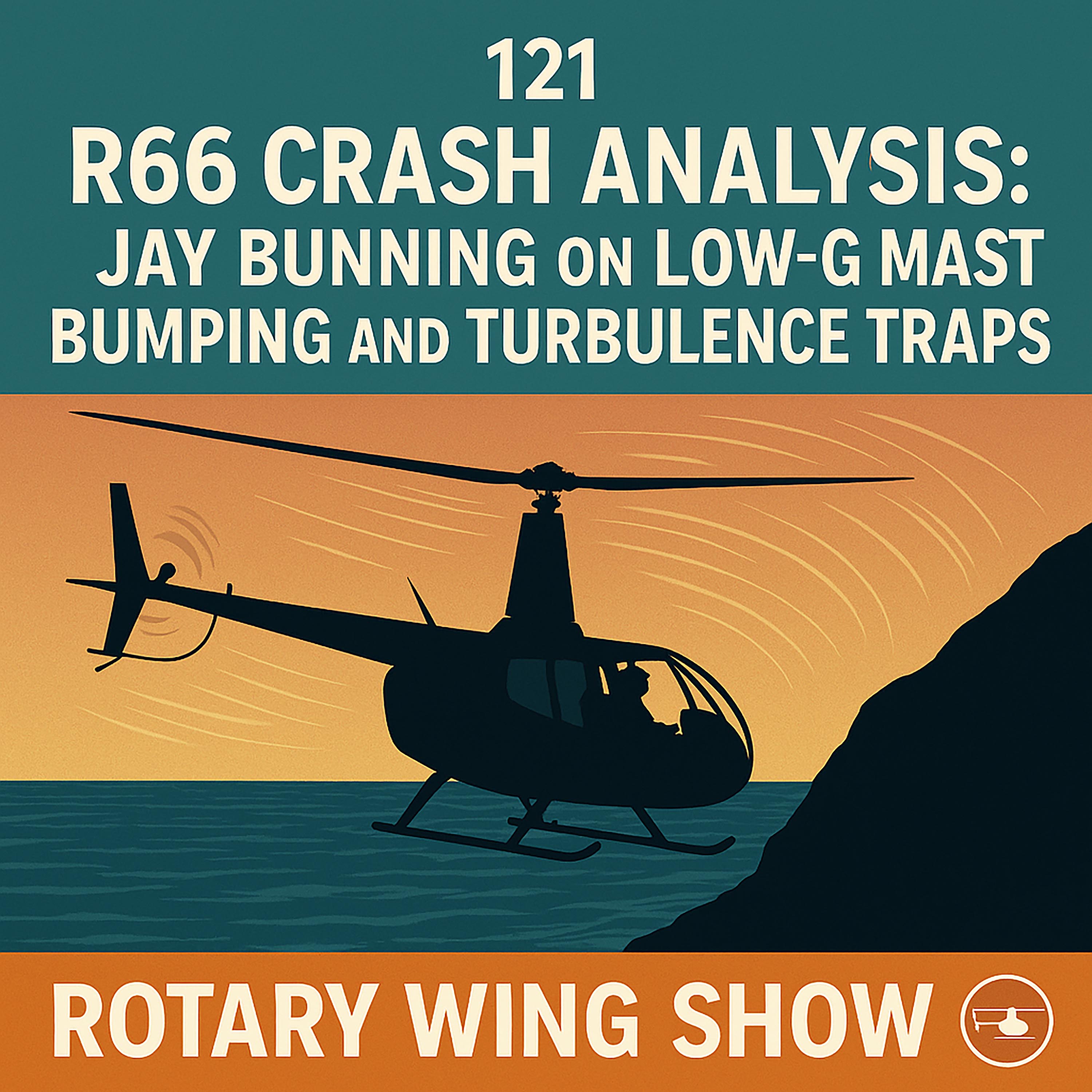

Radio and PodcastLive Radio & PodcastsR66 Crash Analysis: Jay Bunning on Low-G Mast Bumping and Turbulence Traps
Max talks with Jay Bunning about the crash of a Robinson R66, VH-KFT, in Australia that claimed the life of its pilot on October 26, 2023. In addition to the final report , ATSB created a video about the crash . The acci...
About This Episode
R66 Crash Analysis: Jay Bunning on Low-G Mast Bumping and Turbulence Traps is an episode from Rotary Wing Show - Interviews from the Helicopter Industry by Max Trescott | Aviation News Talk Network. Max talks with Jay Bunning about the cras...
This episode belongs to Rotary Wing Show - Interviews from the Helicopter Industry.
Use the player on this page to stream the episode online.
Published Oct 20, 2025, 52:40 long, audio available.
Questions About This Episode
What is R66 Crash Analysis: Jay Bunning on Low-G Mast Bumping and Turbulence Traps about?
Max talks with Jay Bunning about the crash of a Robinson R66, VH-KFT, in Australia that claimed the life of its pilot on October 26, 2023. In addition to the final report , ATSB created a video about the crash . The accident offers vital lessons for all pilots flying teetering-rotor systems such as the R22, R44, R66, Bell 206, 505, and others. Mentioned on the Show Please take our listener survey to help guide the show HelicopterTrainingVideos.com Jay explains that the R66 in this case was nearly new with fewer than 120 hours. The private pilot departed Cessnock Airport for a short VFR flight but diverted east toward the coast to remain clear of clouds at about 1,000 feet. With 25–30-knot southerly winds striking a steep 700-foot headland, the aircraft encountered severe mechanical turbulence. A strong updraft produced a low-G condition—a situation in which the helicopter momentarily loses positive G-force on the rotor system. In that instant, the fuselage and rotor disc move independently, and if the pilot attempts to correct roll with lateral cyclic rather than gentle aft cyclic, mast bumping can occur. Within just 3.4 seconds, the R66 rolled beyond inverted, separated in flight, and crashed into the sea. Thanks to a factory-installed cockpit camera, investigators could analyze the pilot’s exact cyclic movements. The disturbing footage revealed the pilot eating from a bowl with the right hand while the autopilot flew the aircraft. When turbulence hit, the pilot grabbed the cyclic awkwardly with the left hand—unbraced and using the non-dominant arm—while also manipulating a cell phone moments earlier. Jay notes that this combination of distraction, turbulence, and incorrect recovery inputs created a “perfect storm.” The conversation explores the aerodynamics of low-G events, including why teetering systems are vulnerable when unloaded and how horizontal stabilizer design can exacerbate right-roll tendencies. Robinson’s earlier models used an asymmetric stabilizer mounted on the right side of the tail boom, which generated downward lift and contributed to right rolls during low-G conditions. The company has since introduced a symmetrical stabilizer retrofit, now standard on all new helicopters and available at cost to existing owners—a change Jay strongly urges all operators to adopt. Training is another key theme. Jay describes how his flight school safely simulates low-G recognition and recovery without violating limitations, helping pilots build instinctive reactions. “If you feel light in the seat,” he says, “the first response is gentle aft cyclic—never lateral cyclic.” Pilots should also maintain turbulent-air penetration speeds of 60–70 knots instead of cruising at 110 knots, which magnifies control sensitivity and reduces reaction time. Max and Jay broaden the discussion to turbulence awareness and terrain effects. They describe how updrafts form on windward slopes and downdrafts on the lee side, why whitecaps or “cat’s paws” on the water reveal strong surface winds, and how visualizing air like flowing water helps anticipate areas of vertical movement. Both emphasize the importance of scenario-based training—teaching pilots to anticipate risk factors, recognize the first signs of turbulence, and react before a low-G event develops. Human factors were also central to this tragedy. The pilot’s preoccupation with eating and phone use, coupled with reliance on the autopilot, created a delayed response. “Autopilots don’t save you from physics,” Max observes. Jay adds that even moderate turbulence should cue the pilot to disengage automation, slow down, and focus fully on flying. In the final minutes, Max and Jay discuss weather briefings, mountain-wave awareness, and how lenticular clouds or calm surface winds below strong aloft tailwinds can warn of hazardous shear layers. They close with a call for every Robinson owner to upgrade to the symmetrical stabilizer and review low-G recovery techniques. Key Takeaways: Avoid abrupt forward cyclic inputs or pushing over terrain. If you feel light in the seat, use gentle aft cyclic to reload the rotor. Never apply opposite lateral cyclic to correct a right roll. In turbulence, slow to 60–70 knots. Maintain full attention—no food, phones, or multitasking. Consider the symmetrical stabilizer retrofit for added safety.
Where can I listen to R66 Crash Analysis: Jay Bunning on Low-G Mast Bumping and Turbulence Traps?
You can listen to R66 Crash Analysis: Jay Bunning on Low-G Mast Bumping and Turbulence Traps online on Radio and Podcast. Open the player on this page to stream the available audio.
Which podcast is R66 Crash Analysis: Jay Bunning on Low-G Mast Bumping and Turbulence Traps from?
R66 Crash Analysis: Jay Bunning on Low-G Mast Bumping and Turbulence Traps is an episode from Rotary Wing Show - Interviews from the Helicopter Industry by Max Trescott | Aviation News Talk Network.
How long is this episode?
This episode is 52:40 long.
When was this episode published?
This episode was published on Oct 20, 2025.
Can I save R66 Crash Analysis: Jay Bunning on Low-G Mast Bumping and Turbulence Traps for later?
Yes. Use the heart button on the episode page to add it to your favorite episodes list.
Are there related episodes from Rotary Wing Show - Interviews from the Helicopter Industry?
Yes. This page shows related episodes from Rotary Wing Show - Interviews from the Helicopter Industry when more episodes are available from the podcast feed.
Quick Answers About This Episode
Where can I listen to R66 Crash Analysis: Jay Bunning on Low-G Mast Bumping and Turbulence Traps?
You can listen to R66 Crash Analysis: Jay Bunning on Low-G Mast Bumping and Turbulence Traps on this page when the episode audio is available from the podcast feed.
Which podcast is this episode from?
R66 Crash Analysis: Jay Bunning on Low-G Mast Bumping and Turbulence Traps is from Rotary Wing Show - Interviews from the Helicopter Industry by Max Trescott | Aviation News Talk Network.
What are the episode details?
Published Oct 20, 2025 and 52:40 long