How to Design Better Experiments with Expected Information Gain
May 1, 2026 - 00:05:42
Radio and PodcastLive Radio & PodcastsFetching episode details...
Radio and PodcastLive Radio & Podcasts
Support & Resources → Support the show on Patreon → Bayesian Modeling Course (first 2 lessons free) Our theme music is « Good Bayesian », by Baba Brinkman (feat MC Lars and Mega Ran). Check out his awesome work Takeaways...
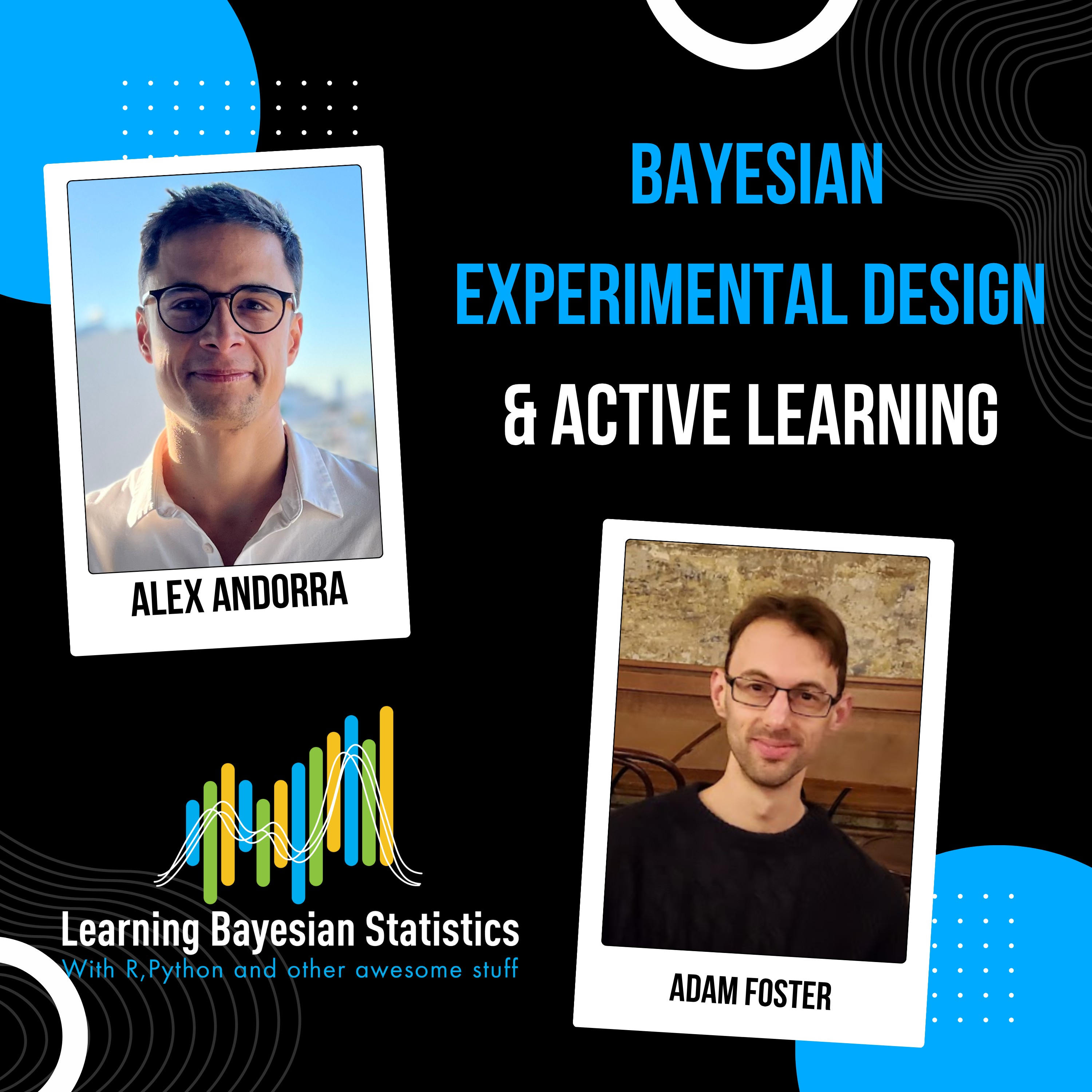
#156 Bayesian Experimental Design & Active Learning, with Adam Foster is an episode from Learning Bayesian Statistics by Alexandre ANDORRA. Support & Resources → Support the show on Patreon → Bayesian Modeling Course (first 2 lessons free)...
This episode belongs to Learning Bayesian Statistics.
Use the player on this page to stream the episode online.
Published Apr 25, 2026, 01:16:43 long, audio available.
Support & Resources → Support the show on Patreon → Bayesian Modeling Course (first 2 lessons free) Our theme music is « Good Bayesian », by Baba Brinkman (feat MC Lars and Mega Ran). Check out his awesome work Takeaways Q: What is Bayesian experimental design and what problem does it solve? A: It's the practice of using a Bayesian model to decide how to collect data before you collect it. Most statistical thinking starts with a fixed dataset. Bayesian experimental design sits upstream -- you have control over experimental parameters (which questions to ask, which reagents to mix, which conditions to test) and you want to choose them optimally. The Bayesian angle is to ask: what new data would most reduce my current uncertainty? Q: When should you actually use Bayesian experimental design? A: When two conditions hold: you have active control over how data is collected (not just passive observation), and you have a Bayesian model whose prior predictive distribution gives a reasonable picture of what typical data might look like. It's especially valuable when data collection is expensive or irreversible -- when the "committal step" of running an experiment has real cost, it's worth doing the analysis first. Q: What is expected information gain (EIG) and why is it central to Bayesian experimental design? A: EIG is the score you assign to a candidate experimental design -- the amount of information you expect to gain about your model parameters by running an experiment with that design. You compute it by simulating datasets from your prior predictive, doing Bayesian inference on each, and averaging how much the uncertainty decreased. What's remarkable is that you can derive the same quantity from two completely different starting points -- reducing parameter uncertainty, or maximizing outcome uncertainty while correcting for noise - and arrive at the same formula. That convergence is why EIG keeps being re-discovered independently across fields. Full takeaways here Chapters : 00:00 What is Bayesian experimental design and why does it matter? 00:06:02 What problem does Bayesian experimental design actually solve? 00:08:54 When should practitioners use Bayesian experimental design? 00:12:00 Is Bayesian experimental design changing how scientists work in practice? 00:15:04 What are the limitations of Bayesian experimental design? 00:17:55 What is expected information gain (EIG) and how does it work? 00:21:05 How do you compute expected information gain in practice? 00:23:48 What is active learning and how does it connect to Bayesian experimental design? 00:41:02 What is active learning by disagreement? 00:48:57 What is deep adaptive design and when should you00: use it? 00:56:02 How is Bayesian experimental design applied in protein dynamics and quantum chemistry? 01:01:58 What does a practical Bayesian experimental design workflow look like? Thank you to my Patrons for making this episode possible! Links from the show
You can listen to #156 Bayesian Experimental Design & Active Learning, with Adam Foster online on Radio and Podcast. Open the player on this page to stream the available audio.
#156 Bayesian Experimental Design & Active Learning, with Adam Foster is an episode from Learning Bayesian Statistics by Alexandre ANDORRA.
This episode is 01:16:43 long.
This episode was published on Apr 25, 2026.
Yes. Use the heart button on the episode page to add it to your favorite episodes list.
Yes. This page shows related episodes from Learning Bayesian Statistics when more episodes are available from the podcast feed.
You can listen to #156 Bayesian Experimental Design & Active Learning, with Adam Foster on this page when the episode audio is available from the podcast feed.
#156 Bayesian Experimental Design & Active Learning, with Adam Foster is from Learning Bayesian Statistics by Alexandre ANDORRA.
Published Apr 25, 2026 and 01:16:43 long