How to Design Better Experiments with Expected Information Gain
May 1, 2026 - 00:05:42
Radio and PodcastLive Radio & Podcasts
• Support & get perks ! • Bayesian Modeling course (first 2 lessons free) Our theme music is « Good Bayesian », by Baba Brinkman (feat MC Lars and Mega Ran). Check out his awesome work ! Takeaways : Q: Why was GPJax crea...
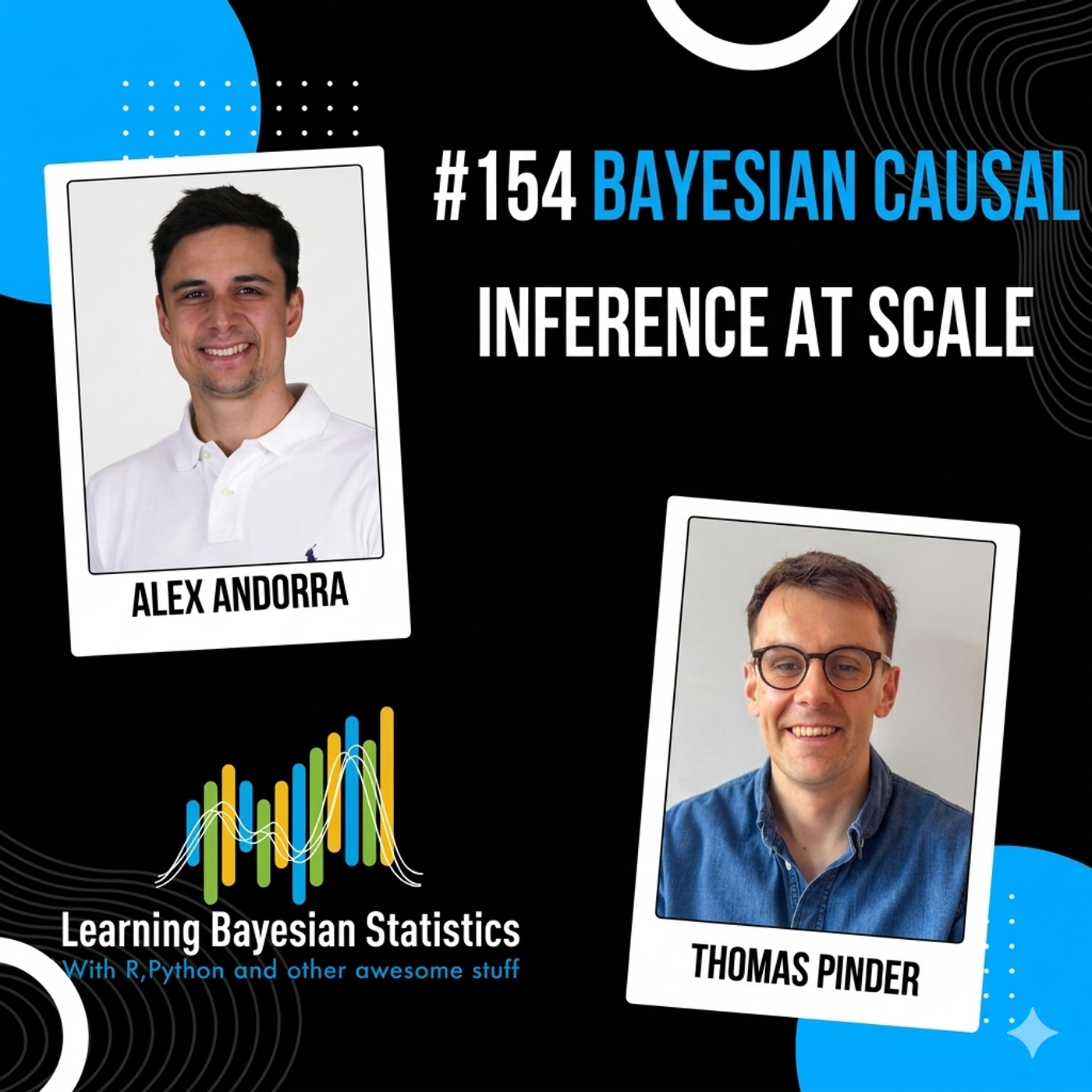
#154 Bayesian Causal Inference at Scale, with Thomas Pinder is an episode from Learning Bayesian Statistics by Alexandre ANDORRA. • Support & get perks ! • Bayesian Modeling course (first 2 lessons free) Our theme music is « Good Bayesian »...
This episode belongs to Learning Bayesian Statistics.
Use the player on this page to stream the episode online.
Published Mar 25, 2026, 01:26:18 long, audio available.
• Support & get perks ! • Bayesian Modeling course (first 2 lessons free) Our theme music is « Good Bayesian », by Baba Brinkman (feat MC Lars and Mega Ran). Check out his awesome work ! Takeaways : Q: Why was GPJax created and how does it benefit researchers? A: GPJax was developed to provide a high-performance, flexible framework for Gaussian processes (GPs) within the JAX ecosystem. It allows researchers to move beyond black-box implementations and easily experiment with custom kernels and model structures while leveraging JAX’s automatic differentiation and GPU acceleration. Q: What are the primary advantages of using Gaussian processes for data modeling? A: Gaussian processes are highly effective at modeling complex, nonlinear relationships in data. Unlike many machine learning methods that only provide a point estimate, GPs offer built-in uncertainty quantification, which is essential for understanding the reliability of predictions in research and industry. Q: How does the GPJax and NumPyro integration enhance probabilistic modeling? A: The integration allows users to treat GPJax models as components within a larger NumPyro probabilistic program. This combination enables the use of advanced sampling techniques like NUTS (No-U-Turn Sampler), making it easier to build and fit complex hierarchical models that include Gaussian processes. Q: What are the main challenges when applying Gaussian processes to high-dimensional data? A: High-dimensional data significantly complicates GP modeling due to the curse of dimensionality and the cubic scaling of computational costs. In high dimensions, defining meaningful distance metrics for kernels becomes harder, often requiring specialized techniques like sparse GPs or dimensionality reduction to remain tractable. Full takeaways here ! Chapters: 11:40 What is GPJax and how does it simplify Gaussian Process modeling? 15:48 How are Bayesian methods used for experimentation and causal inference in industry? 18:40 How do you implement Bayesian Synthetic Control? 32:17 What is Bayesian Synthetic Difference-in-Differences? 39:44 What are the research applications and supported methods for the GPJax library? 45:47 What are the primary software and computational bottlenecks when scaling Gaussian Processes? 49:02 What are the real-world industrial applications of Gaussian Process models? 54:36 How is Bayesian modeling applied to soccer and sports analytics? 58:43 What is the future development roadmap for the GPJax ecosystem? 01:05:37 What is Impulso and how does it integrate into a Bayesian modeling workflow? 01:13:42 How do you balance Bayesian computational overhead with industrial latency requirements? 01:20:26 Why is there optimism that scalable Bayesian methods for causal inference are now within reach? Thank you to my Patrons for making this episode possible! Links from the show here!
You can listen to #154 Bayesian Causal Inference at Scale, with Thomas Pinder online on Radio and Podcast. Open the player on this page to stream the available audio.
#154 Bayesian Causal Inference at Scale, with Thomas Pinder is an episode from Learning Bayesian Statistics by Alexandre ANDORRA.
This episode is 01:26:18 long.
This episode was published on Mar 25, 2026.
Yes. Use the heart button on the episode page to add it to your favorite episodes list.
Yes. This page shows related episodes from Learning Bayesian Statistics when more episodes are available from the podcast feed.
You can listen to #154 Bayesian Causal Inference at Scale, with Thomas Pinder on this page when the episode audio is available from the podcast feed.
#154 Bayesian Causal Inference at Scale, with Thomas Pinder is from Learning Bayesian Statistics by Alexandre ANDORRA.
Published Mar 25, 2026 and 01:26:18 long